
Author Archive
Big Ass Sandwich
by Chris on May.25, 2010, under Main Page

It's mighty mighty, just lettin' all hang out!
I will let the picture do the talking. (Yes, the fries are right on the sandwich).
Big-Ass Sandwich is a cart on SW 3rd and Ash, right across the street from Captain Ankeny’s Well. I discovered it about two weeks ago, and I am very glad that I did. That is one tasty sandwich, although I hate to think of the calories in this sucker. But trust me, it is definitely worth it.
All the meats are prepared fresh each day, and the owner makes the béchamel cheese sauce by hand. Toss on some fresh cut home-fries and a little Ardvark spicy sauce, and you are ready to walk and roll.
Today I went for the turkey version, but I’ve also had the roast beast and they are both fantastic. The ham will be my next treat.
In addition to the sandwiches, Big-Ass is kick-ass in other ways too. They take credit cards, which is rare for a cart, and they do it with a very neat little device that plugs into an iPhone. Speaking of iPhones, if you have one you can download an App and pre-order your lunch. Awesome.
Feeling like that might just be too much sandwich for you? They make a Half-Ass version as well. However, if you order that be prepared to be ridiculed: Max ordered a Half-Ass the other day and they called him Christine the rest of the time he was there. They even introduced him as Christine to other patrons. If nothing else makes you want to eat there, that should.
You can check out all their details here.
Happy Birthday, Pac-Man!
by Chris on May.22, 2010, under Main Page, Tidbits
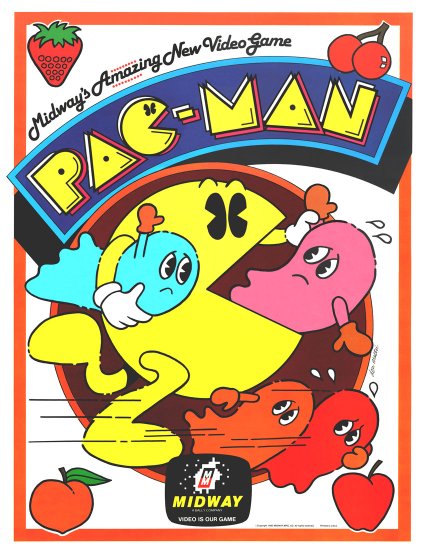 I don’t know about you, but I was a total Pac-Man kid: When I was three my birthday cake was Pac-Man; The first game I ever played on my Atari 2600 was Pac-Man; I wiled away countless hours playing with my Pac-Man game watch; I tuned in every Saturday morning to watch the Pac-Man cartoon show. The first really expensive thing I ever bought was a portable Pac-Man game which was vaguely Pac-Man shaped and cost $50 dollars. At the time my allowance was $5 a week, so it took me a total of 10 weeks to save up for it. I need not tell you that 10 whole weeks to a five or six year old is roughly equatable to two or three life times.
Today we celebrate because the the 1980 icon and childhood hero turns 30 years old.
A Really Hairy Situation
by Chris on May.18, 2010, under Tidbits
As we’ve all been seeing and hearing on the nightly news, the Deepwater Horizon disaster is a shocking calamity. The original estimates of 5,000 gallons of oil gushing into the sea every day appear to have been greatly underestimated. According to an article in The NY Times there may be as much as 200,000 gallons of oil freeflowing into the Gulf of Mexico per day, and with an expected time-line of 90 days before a relief well can be drilled, this could and probably will become the worst environmental disaster this country – and perhaps the world – has ever seen.
Several different solutions have been tried, running the technological gambit: two different attempts at covering the break in the wellhead with large concrete “boxes” have both failed, a smaller pipe was inserted into the well to and staunch the flow which failed as well, and now they are trying something called a junkshot – litterally putting garbage in the pipe and hoping that it will fill the gaps and fissures in the ruptured concrete enough to allow the wellhead to be filled with mud and concrete.
Making matters worse we now have evidence that huge plumes of oil are building underwater instead of rising to the surface, some measuring as large as 10 miles long, three miles wide and 300 feet thick. These plumes are having an unexpected consequence: the oil is consuming the oxygen in the surrounding water that isn’t contaminated with petroleum, which could very quickly leave large swatches of ocean uninhabitable for local sea life. Naturally, this will have an even larger impact on the beleaguered seafood trade in Lousiana, not to mention the environmental impact on the whole Gulf Coast region.
For the oil that is reaching the surface and beaches, there is also some interesting and innovative techniques being used to contain and clean up the oil. One very successful discovery from the infamous Exxon Valdez spill in Alaska’s Prince William Sound was that human hair and bird feathers soak up petroleum better than almost anything else on earth.
To that end salons all over the country are donating hair to the recovery effort, lead by San Francisco’s Matter of Trust, a non-profit organization which is donating more than 400,000 pounds of hair to the clean up effort. But you can’t just drop all those locks on the oily ocean and let it form one big, nasty matted mess. You have to hold the hair in something… and that something apparently is pantyhose.
Hanesbrands, Inc. is donating more than 50,000 pairs of pantyhose to the clean-up efforts through various organizations. As interesting and peculiar as that may be, here is the Tidbit: pantyhose production is drastically down from where is was 20 years ago when the Valdez spilled her toxic cargo in Alaska. Women by and large do not wear them any more.
So wear – I mean where – were those 50,000 pairs that Hanesbrands is donating going to if most women in the country have given up hosiery?
San Francisco.
Apparently pantyhose is still quite popular in the City by the Bay. Most of the reputable news sources I have found fail to offer a suggestion for why this may be, but there are of course many jokes and rumors flying around. All we know for sure is that San Franciscans are going to be going bare-legged for the next little while.
A Rough Week for the Z and Growler
by Chris on May.13, 2010, under Main Page
As the title of this post suggests, its been a bit of a bummer of a week. Well, to be fair, it started out as a bummer of week, the ending has been getting better. It just feels like the whole week has been crappy because I have spent a large part of it dealing with insurance companies, and I really, really, really hate insurance companies.
Especially Geico.
 It started last Friday night when Shannon and I were on our way to see Iron Man 2. (Not bad, by the way. Not fantastic, but entertaining nonetheless.) We were pulling into the parking lot at Bridgeport Village when the woman driving the big SUV in front of me decided she wanted a parking space that was about to become available, so she put it in reverse and started backing up – toward me. I backed up as far as I could, but eventually ran out of room, and she just ran smack into me. As if that weren’t bad enough, after she hit me she paused for a few seconds, allowing the car behind me to back up a little which in turn allowed me to back up a couple of feet, and then she backed into me a second time! The damage, as you can see, is not horrible but it certainly did piss me off.
Cinco de Mayo
by Chris on May.01, 2010, under Tidbits
With Cinco de Mayo right around the corner, I thought it was probably time to do a little research on the holiday. I remember learning a very brief history of the what holiday was about when I was in grade school, but that was little more than a few paragraphs in a boring history book, which said that Cinco de Mayo was basically Mexican Independence Day. I learned a few more details recently and thought I’d share them.
First, I’ll start with the tidbits:
- Cinco de Mayo is largely ignored in Mexico, only having real significance in the region near Pueblo, where the battle against French forces took place.
- The United States has celebrated Cinco de Mayo since 1863 or 1867 (depending on your source) when California sponsored the first celebration.
- In Canada there is an annual Cinco de Mayo Skydiving competition.
- In the island nation of Malta Cinco de Mayo is remembered with a Mexican beer drinking event.
- In the Cayman Islands there is an annual Cinco de Mayo air guitar competition.
I read the following synopsis of Cinco de Mayo by historian John Schmal and decided to post it verbatim, since I thought it would be difficult to improve upon. (I particularly loved the part where the French are promised by the ousted Mexican Conservatives that they’re military forces would be met with open arms, the same lie that our own Conservatives told us when they said our troops would be met with “flowers and chocolates” if we invaded Iraq.)
In 1855, after two decades of Conservative administrations, the Liberal Party, advocating a system of government similar to that of the United States, came to power in Mexico. This change in government led to a period of significant political change and untold violence known as La Reforma (The Reform). In a series of sweeping decrees brought about by the Constitution of 1857, special privileges were abolished. These laws threatened the established order — the large landowners, the Catholic Church, and the army — all of which had occupied a privileged position during the colonial period and under the traditional Conservative governments.
The changes were so drastic that a three-year civil war broke out. After a great deal of bloodshed, the Conservatives were finally defeated. However, the war had been costly, not only in lives lost, but in regards to Mexico’s economic resources. Mexico’s agricultural and mining production, upon which the national economy had depended, ground to a halt, causing the Mexican government to incur a heavy foreign debt. President Benito Juarez became the leader of the economically prostrate republic in 1861. But the Conservative leadership, still determined not to let the Liberals stay in control, appealed to outside forces for help. The Conservatives had come to believe that the answer to the problems of Mexico lay in the establishment of a monarchy under a foreign prince. Their search brought them to France, then under the rule of Emperor Napoleon III.
Napoleon III had been eager to surpass the glories of the first Napoleon. During this time, Napoleon’s army was reputed to be the finest in Europe with the best weaponry and excellent training, leadership, and experience. Conservatives meeting with Napoleon in Paris assured him that a French invasion of Mexico was feasible and that French forces would be warmly welcomed by the Mexican people. In April 1861, the United States had become engulfed in its own Civil War and was not likely to offer much opposition to a French invasion.
In July 1861, the Juarez government declared a two-year moratorium on the payment of Mexico’s huge foreign debt. In those days, international law permitted the use of armed forces by creditor nations in such situations, so in October 1861, the chief creditors — Great Britain, France, and Spain — protested to Juarez and signed the Convention of London, by which they agreed on a joint occupation of the port of Veracruz to enforce their claims. The three powers proceeded with their joint military intervention, but, after a short operation, Britain and Spain withdrew. France, however, continued its occupation of Veracruz and started to march inland to occupy Mexico City and take control of the entire nation.
On April 19, 1862, 6,000 seasoned French troops under General Latrille set out to capture Mexico City, 400 miles inland. Informed by the Conservatives that the French would be welcomed with open arms, General Latrille marched toward the small village of Puebla. On May 4, the French camped in sight of Puebla on a plateau, approximately halfway between the coast and Mexico City. The next day, General Zaragoza, commanding the Mexican forces, decided to attack the French forces, hoping to cripple or slow their advance in order to give precious time to the Mexican army in the capital.
The decisive action of the day was carried out by young Brigadier General Porfirio Diaz, who repelled a determined but reckless assault by the French on Zaragoza’s right flank. The Mexican soldiers, lacking battlefield experience and armed with outdated artillery and muskets, attacked with determination and fervor. In a four-hour battle, the Mexicans suffered only 250 casualties, while inflicting heavy losses on the French. Losing nearly a thousand men, the French withdrew back to the coast to await reinforcements. The French waited for a year before they began to move back inland. However, this time, the French forces, numbering 30,000 troops, were able to take Mexico City, where they installed Maximilian of Hapsburg as the Emperor of Mexico. Juarez and his government were driven to the border of Texas.
As it turns out, Emperor Maximilian, the younger brother of Emperor Franz Josef of Austria, was not what the Conservatives had hoped for. While refusing to rescind the liberal reforms of his predecessors, Maximilian also declared a free press and proclaimed a general amnesty for political prisoners. But he also signed a decree in October 1865, in which the death penalty was made mandatory for all captured Juaristas still bearing arms. In early 1867, Napoleon decided to withdraw his troops and Maximilian was left without support. Taking personal command of the Mexican Imperial Army, Maximilian found that he lacked the support of the people and was quickly surrounded by republican troops. On May 15, 1867, Maximilian surrendered to General Mariano Escobedo. A month later, Maximilian was executed, ending — once and for all — French influence in Mexico.
Fifty thousand Mexicans lost their lives fighting the French forces. But the experience, however tragic and costly, led to the beginning of a national self-esteem which began to grow perceptibly in the years to follow. Even during the French occupation, many of the Mexican people had celebrated Cinco de Mayo as a holiday in the areas not under French occupation. In time, Cinco de Mayo came to symbolize national pride and the triumph of the people over foreign occupation.
John Schmal is an historian, genealogist, and lecturer. With his friend Donna Morales, he coauthored “Mexican-American Genealogical Research: Following the Paper Trail to Mexico” (Heritage Books, 2002). He has degrees in History (Loyola-Marymount University) and Geography (St. Cloud State University) and is a board member of the Society of Hispanic Historical Ancestral Research (SHHAR). He is an associate editor of SHHAR’s online monthly newsletter, www.somosprimos.com. John is presently collaborating with Eddie Martinez — a graphics illustrator — on a manuscript entitled “Indigenous Mexico: Past and Present.”
-
Welcome to the Think Tank
 We've made some improvements around here, as you have probably noticed. Read the posts to see what we've been up to lately, and don't feel bashful about commenting if you like! And don't forget, Friends.ThinkTankGallery is updated regularly with new photos, so check there often.
Stay updated by subscribing to the RSS feed.
