
Author Archive
April Fool’s Day
by Chris on Apr.01, 2010, under Main Page, Tidbits
Joel sent me an interesting link today regarding the origins of April Fool’s Day, which set me off on a little internet search for Tid Bits about the day to celebrate jokes and hoaxes.
The exact origins of April Fools Day is not completely clear, although the most commonly accepted idea is that the tradition started in the 1500’s when the Gregorian calender was adopted. Prior to that, on the Julian Calendar, the New Year started on March 25 (which makes perfect sense to me since that is my birthday) but, since March 25 is in the middle of Holy Week the actual celebration of the new year was held on April 1st.
Celebrating the new year at roughly the same time as the Spring Equinox makes perfect sense: everything is starting anew after a long, hard winter. The weather is warming, the trees and flowers are blooming, and the rabbits are… well, they are doing what rabbits do. For those reasons and many others, the new Gregorian date was met with resistance by many people and as such they continued to celebrate the New Year on April 1st. This seemed very foolish for those who did get (and accept) the memo, and those enlightened folks gave the foolish oldschooler’s the lasting moniker of April Fools.
Since that time traditions have evolved somewhat from pure admonishment to general bafoonery and joke making. Many individuals have fallen prey to these endeavors over the years, but in my reading today I found out about several large-scale jokes which have been pulled on an unsuspecting populace.
Here are some of my favorites:
The costs of owning a car
by Chris on Mar.18, 2010, under Tidbits
Today at work Joel and I got into another Blatantly Ridiculous Argument. We average two or so BRA’s a week, but so far this week we’ve already hit our quota.
Today’s BRA was over the relative costs of owning and operating a car versus using public transportation. It started when Joel pointed out that Google Maps now includes a cost calculator with their public transit mapper, showing the difference in cost between mass transit and a private automobile.
As an example, here is a screen shot of the route between my house and Shannon’s.
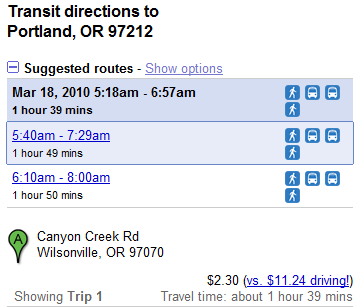
I said that those numbers were clearly crazy, that is did not possibly cost $11.24 to drive to Wilsonville. We looked it up and found that it was based on the amount per mile that the IRS allows you to deduct for business driving, which for 2010 is $.50 per mile.
Joel’s contention, or at least as far I was able to tell because the argument quickly degenerated into ridiculousness, was that those numbers may be somewhat inflated but were probably generally accurate when you accounted for registration, insurance, repairs, tickets, and all the other expenses.
I said that those things were indeed an added expense, but that a three zone bus pass alone was $900 dollars (it is actually $946). And of course, buses can’t take you everywhere you need to go. You would need to augment that with taxi cabs, a bicycle (which has a surprisingly expensive maintenance schedule, more than $400 last year for me, not mention the cost of the bike itself), AmTrak/Greyhound tickets for longer journeys, or some combination of the above. Joel said that you could hitch rides with friends to most places you needed to go when you couldn’t take the bus, but as I pointed out, if you want an accurate comparison of what it costs to transport someone from point A to point B, those trips would still need to be counted, at least partially. Just because the person in question is not paying for the ride, it still costs somebody. It’s akin to arguing that your annual out-of-pocket vehicle operating costs are very low because your parents or spouse pay for your insurance and/or gasoline. Whoever is paying for it, the money is still being spent.
For an accurate comparison, the question has to be “How much does it costs to transport 1 person 15, 000 miles per year?” (15,000 miles per year is the number of miles that AAA, IRS and most everyone else uses for the annual average in the US).
So, I did a little reading. It turns out that it is almost impossible to answer the overall question because there is no hard data for what the actual average expense of automotive ownership is: all of the data is based on new cars with an average price of $28,400, and factor in depreciation, annual interest rate on a car loan, full insurance, etc… which of course does not take into account anyone who, like myself, does not have a car loan, carries minimum insurance, drives a car which is worth less than $2,000 dollars, etc. In fact, in a completely unscientific survey of the people that I regularly spend time with, I can only think of two people who currently have a car payment, and only one of those is for a new car. And that car was not $28k dollars.
Personally I have never had a car payment because I have always paid cash for my vehicles. The most expensive car I’ve ever owned cost me $5,000 and the least expensive car was $100. The average price of the vehicles that myself or my family have owned is $2,550. (That excludes the $100 piece of garbage. We had it for about a month while we were between “real” cars.)
I tried but I could not find the national average cost of using strictly public buses, AmTrak/Grayhound, taxi’s, etc. Throwing a bicycle into the mix drastically reduces the expense of traveling, but for the purposes of this argument I wasn’t considering bicycles because Google did not estimate what it cost to ride a bike, only the supposed difference between operating a car and taking the bus.
I was able to find some interesting things, even if they do not really clear up the overall equation. First, Google’s numbers are indeed questionable. As I said, they used the $.50 cent per mile IRS rate for deducting business mileage, but even the IRS does not think that all mileage is worth $.50 a mile. In fact, Medical expense is only deductible at $.34 cents per mile, and moving mileage is only worth $.19 cents per mile. Personal mileage is not deductible, nor is commuting too and from work.
I’m not sure what all went into the IRS formula to come up with the $.50 per mile number, but I do know that in 2009 the number was $.55 cents per mile, and that average gasoline prices and average new car prices have not fallen in the same period, so I’m not sure that can be used as an accurate measure. Especially when coupled with the sliding scale model that the IRS uses for different types of travel.
I consistently found numbers from the Automobile Association of America regarding average operating and ownership expenses for the US, so I went with those for the purposes of this task. Those numbers were based on a new car, with full insurance, and factored in depreciation, etc. The numbers were also focused only on the first 5 years of ownership, which skew them to the highside because of the yearly depreciation of the vehicle, which is very high for the first few years.
The numbers below show my actual expenses versus the national averages according to AAA. Some of the numbers are hard to quantify, like the maintenance/repair expense for the Corsica. I went back through my records and wrote down everything that I found, but those were mostly larger expenditures. $1850 is what I came up with for maintenance expenses over the 9 years that I’ve owned my car, so I rounded up to $2500 to cover anything that I might have forgotten. The major caveat there, of course, is that with very few exceptions I work on my own cars, so there is no labor in that number. The few repairs that I have paid to have done, I did not to take a garage but instead used a mobile mechanic, who is very affordable.
One other thing to note is that I did not include the depreciation values in the numbers below, because they were very suspect to me. According to AAA’s numbers, the national average for depreciation on a new car is $3,394 per mile. That is clearly wrong. However, even if you assume they meant that to be an annual number, it still doesn’t make sense: after 8.5 years a $28,000 dollar car would be virtually valueless. While an 8 year old car is clearly not worth what it was when it was new, I think we can all agree that it is worth more than $0. So, because of this problem I omitted depreciation completely. This also made the comparison between the national averages and my own expenses easier to relate. My car is very old and has very high mileage, so it is not worth hardly anything, but it is also not depreciating much any more, certainly not like it undoubtedly did in its first couple of years. And I only paid $1,500 for it, so the Kelly Blue Book depreciation has been very little. In reality I think I can easily get more than KBB for it because a car in good condition that runs is almost always worth $1000 bucks to someone, even if it has high miles.
| National Average (AAA) | Personal (Corsica) | |
| Price of car | $28,400 | $1,500 |
| Miles Driven – Annual | 15000 | 7000 |
| Operation | ||
| Fuel – (per mile) | $0.094 | $0.126 |
| Repairs/Upkeep – per mile | $0.047 | $0.019 |
| Tires – per mile | $0.008 | $0.008 |
| Annual Average @ 10k per year | $1,490.000 | $1,530.000 |
| Ownership | ||
| Registration/License/Tax – Annual | $544 | $36.50 |
| Insurance – Annual | $955 | $600 |
| Finance – Annual (10% down, 6%, 5yr) | $743 | 0 |
| Average per year | $2,780 | $636.50 |
| Annual Cost @ 10k per year | $4,270.000 | $2,166.50 |
| Total Cost per mile | $0.43 | $0.22 |
One interesting thing was the cost of fuel per mile. My math worked out to be higher than AAA’s number, even though the EPA’s estimated national average for MPG is lower than the 23.5 that I worked out for my car. So I’m not sure what to think about that.
I assume that my information is probably on the low end, but the national averages that AAA have quoted here are, in my opinion, pretty high, and those numbers don’t include depreciation. Adding AAA’s depreciation numbers in more than doubled the cost of ownership, but as I said, their numbers seemed whack.
I’m guessing that the real average is somewhere in the middle. In any case, both of those numbers are lower than Google’s calculation, with my own numbers being about 80% higher than the bus fair, which is a far cry from the 388% that Google reported. And again, that is 80% higher for one in-city trip.
By comparison, a one-way trip to Seattle costs me roughly 1/2 of a tank of gas, which is approximately $20 dollars, plus ~200 miles worth of wear and ownership expense. That equals roughly $34 using the numbers shown above, adjusted for all highway driving (where my car gets significantly better mileage).
The same trip on AmTrak is $29-$48 dollars depending on the seat you chose, or $31 dollars on Grayhound ($37 for a refundable ticket).
The real kicker comes if you are traveling with more than one person in your car… Two people traveling in the same car reduces the cost of transport-per-person by half (assuming they are not using shared funds), while the cost-per-person on the bus or train is still the same. However, I will admit that is cheating, as everything else has been based on a single occupant.
The thing that surprised me the most from all of this is the AAA national average for insurance premiums: $955. And more than $500 dollars for registration fees? Who the hell pays that much?
Fingerprints of the Gods
by Chris on Mar.14, 2010, under Main Page
 Yesterday Shannon and I were walking through Borders wasting time until her appointment at the Apple Store (iPod versus washing machine, not pretty), and I happened across this book, Fingerprints of the Gods, by Graham Hancock. The description sounded interesting so I downloaded it to my Kindle when I got home.
I’m about 1/3 of the way through it and I am truly enjoying this book. In fact, basically all I’ve done today is read it… well, read it and look up references to things that I found in the book.
Hancock tells the tale of his journey across the globe to investigate some the worlds most ancient archeological sites gathering clues that lead him to a single belief: that somewhere far back in the deepest reaches of antiquity, much farther back in time than conventional wisdom accepts, a technologically advanced and intellectually enlightened human civilization existed. This civilization left its fingerprints on humankind in ways small and large, many of which exist to this very day.
If you are a fan of conventional thinking, this book is probably not for you. If, however, you are open to logical but unpopular ideas, enjoyed Immanuel Velikovsky’s Worlds in Collision and Ages in Chaos, or simply believe that if you find a similar enough story from a wide array of sources there has to be a common truth in there somewhere, you will definitely enjoy this book.
I certainly am.
Shannon’s Wishlist
by Chris on Mar.04, 2010, under Wish Lists
SHANNON’S WISH LIST
| Description | Specifics (Size, color, etc) | Where to buy | Price | |
| Bicycle Equipment | ||||
| Ortlieb Pannier Packing Cubes | Cheaper at CycleBackPacks.com but never purchased from them before | CycleBackPacks, REI, Bike Tired Direct | $36-$50 | |
| Extra Bike Charger | Investigating model… | |||
| Showers Pass Rain Pants | Investigating model… | |||
| Showers Pass Shoe covers | Investigating model… | |||
| Jewelry | ||||
| Movies | ||||
T |
||||
| T | ||||
| Books | ||||
| Powell’s Gift Certificate | ||||
| MISC. | ||||
| Target Gift Certificate | ||||
| Itunes Gift Certificate | ||||
| – | ||||
| $ |
New Seats for the Z
by Chris on Mar.03, 2010, under Main Page
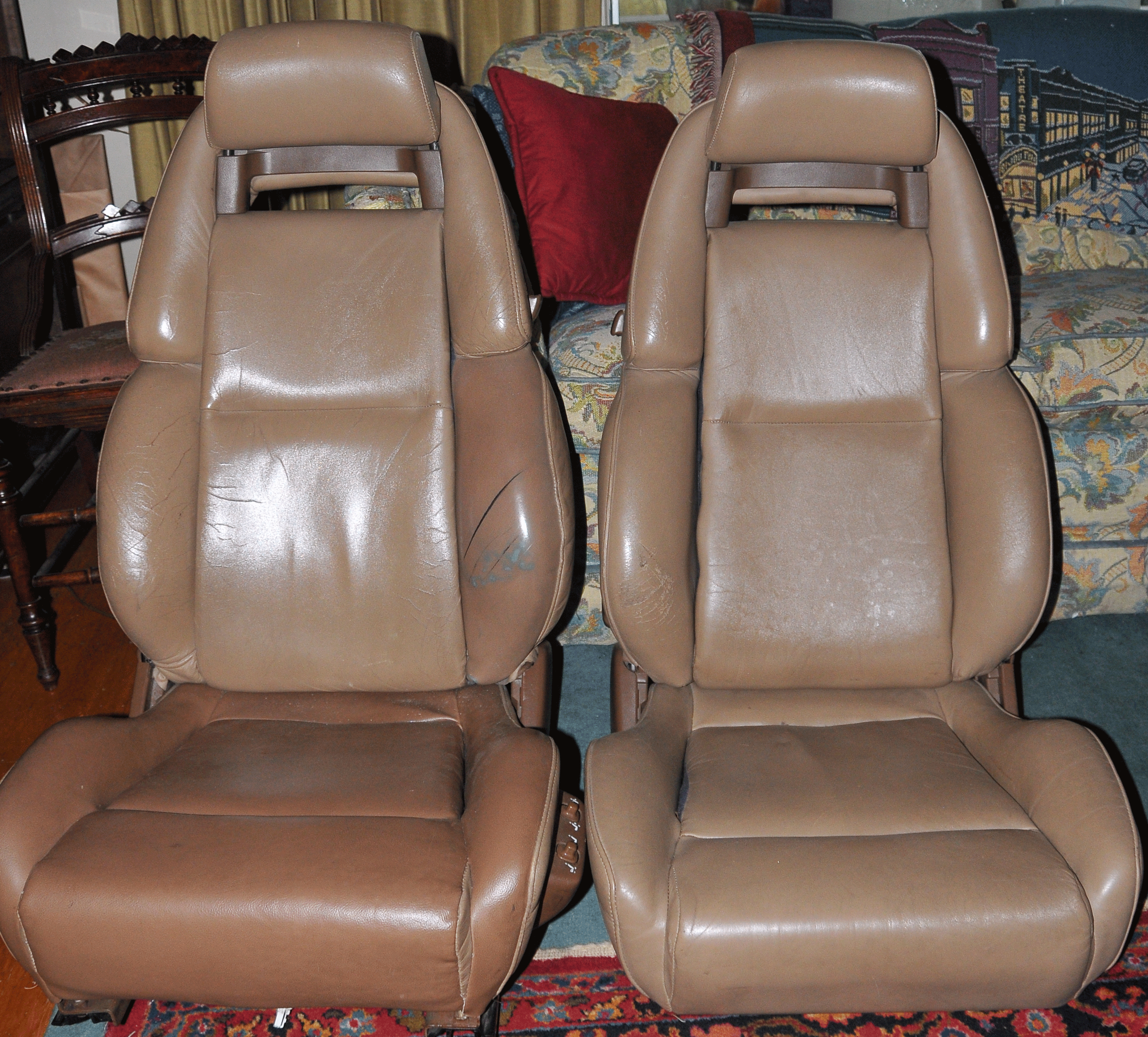 I got a hell of a bargain last night. I’ve been looking for replacement seats for my 1990 300ZX since I bought the car in 2002, but I haven’t found any that were in better condition than mine for less than $600, and that was just for leather alone. I would have had to do all the installation myself. The only other set of tan seats that I’ve found in good condition were on eBay and sold for about $450 dollars, but I was outbid by one dollar with 1/4 of a second remaining. That was in 2003.
Last night these seats came up on Craigslist for $100 for the pair! Needless to say, I snatched them up. As you can see, there are some fine cracks in the leather and a little scuffing here and there (and that black mark, which I think I can remove), but they are in remarkably good shape for 20 year old seats and they are a tremendous improvement over my existing seats. Especially for $100 bucks. Making it even sweeter, one of the tilt controls on my current driver seat is broken, and the best price I’ve been able to find to replace it is $70 dollars. The new seat comes with a working control unit, making this deal that much better.
You can probably tell that I’m a little excited. I’m hoping to get these bad boys installed this weekend.
-
Welcome to the Think Tank
 We've made some improvements around here, as you have probably noticed. Read the posts to see what we've been up to lately, and don't feel bashful about commenting if you like! And don't forget, Friends.ThinkTankGallery is updated regularly with new photos, so check there often.
Stay updated by subscribing to the RSS feed.
